
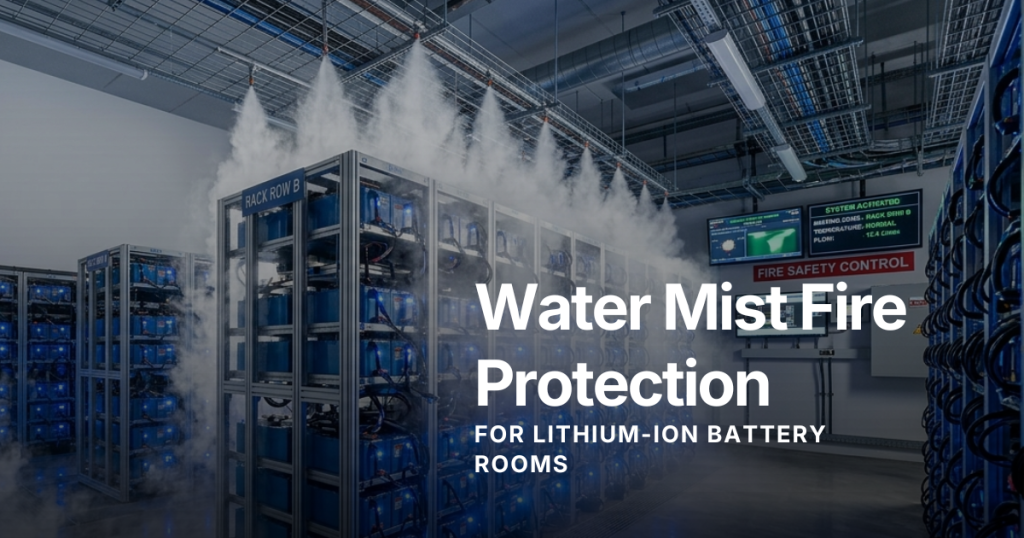
Water Mist Fire Protection for Lithium-Ion Battery Rooms
Understanding the Fire Risks Behind Modern Energy Storage
Lithium-ion batteries have become a critical part of modern infrastructure. They support renewable energy projects, battery energy storage systems (BESS), data centers, industrial facilities, substations, and backup power applications. While these technologies deliver significant operational benefits, they also introduce fire risks that differ substantially from conventional fire scenarios.
Effective battery room fire protection requires more than extinguishing visible flames. Once a lithium-ion battery enters thermal runaway, it can continue generating heat, flammable gases, and fire propagation even after initial suppression efforts appear successful. This is why modern lithium ion battery fire protection strategies focus heavily on heat management, fire containment, and prevention of re-ignition.
As energy storage installations continue expanding across Egypt, the GCC, and worldwide markets, fire protection solutions must evolve alongside them. Governments, utilities, data center operators, and industrial organizations worldwide are increasingly investing in battery energy storage systems, creating a growing need for specialized fire protection strategies capable of addressing lithium-ion battery hazards.
Why Lithium-Ion Batteries Present Unique Fire Challenges
Understanding Thermal Runaway
Thermal runaway is the primary fire hazard associated with lithium-ion battery systems.
The process typically begins when a battery cell experiences an internal failure, mechanical damage, manufacturing defect, electrical fault, or overheating condition. As temperatures rise beyond safe operating limits, the affected cell can release significant amounts of heat and combustible gases.
The challenge is that thermal runaway does not always remain isolated.
Heat can transfer to adjacent cells, creating a cascading event that spreads throughout battery modules and racks. In large battery energy storage systems, this can result in extensive fire development and prolonged incident durations.
Unlike traditional combustible fires, lithium-ion battery incidents often continue producing heat after flames are suppressed. This creates a significant risk of re-ignition if temperatures are not reduced effectively.
For facility operators, this means suppression systems must address both fire control and thermal management.
The Growing Importance of Standards-Based Protection
As battery installations become larger and more common, industry standards have evolved to address these unique hazards.
NFPA 855 establishes requirements for the installation of stationary energy storage systems, while FM Approvals continues to evaluate suppression technologies and fire protection strategies for battery applications.
The growing adoption of battery energy storage systems worldwide has accelerated the development of international fire protection standards and testing methodologies. Organizations such as NFPA, FM Approvals, UL Solutions, and regulatory authorities across Europe, North America, the Middle East, and Asia continue to refine guidance aimed at improving battery fire safety and operational resilience.
Why Water Mist Technology Is Being Evaluated for Battery Applications
The Role of a High-Pressure Water Mist System
A high-pressure water mist system operates differently from conventional sprinkler technology.
Rather than discharging large quantities of water, the system generates extremely fine droplets that absorb heat rapidly and distribute cooling throughout the protected space.
When exposed to high temperatures, these droplets evaporate quickly, creating multiple suppression effects simultaneously:
- Rapid cooling of battery cells.
- Reduction of heat transfer between modules.
- Oxygen displacement around the fire source.
- Limitation of flame propagation.
- Reduction of radiant heat exposure.
For lithium ion battery fire suppression, cooling is often one of the most important objectives. The ability to reduce temperatures quickly helps limit thermal runaway propagation and decreases the potential for re-ignition.
Protecting Critical Infrastructure
The energy sector is increasingly adopting advanced fire protection technologies that balance suppression performance with asset protection.
Battery rooms, electrical substations, transformer facilities, power generation plants, and industrial electrical systems often contain mission-critical equipment where excessive water discharge can create additional operational challenges.
A high-pressure water mist system offers several advantages in these environments:
Reduced Water Damage
Water mist systems use significantly less water than conventional sprinkler systems while still providing effective fire suppression and cooling.
Improved Performance in Confined Spaces
Battery rooms, energy storage containers, electrical rooms, and substations frequently involve compact layouts with high equipment density. Water mist technology can distribute fine droplets throughout these spaces while delivering effective cooling performance.
Enhanced Asset Protection
Reducing fire damage is important. Reducing collateral damage is equally important. Water mist systems help support business continuity by limiting equipment exposure and reducing recovery times.
Support for Regulatory and Insurance Requirements
Properly engineered water mist systems can be designed in accordance with applicable NFPA requirements and FM Approvals guidance, helping facility owners satisfy regulatory and insurance expectations.
Battery Room Fire Protection Best Practices
Fire suppression should never be considered a standalone solution.
Effective battery room fire protection requires multiple layers of defense working together to manage risks throughout the life of the facility.
Key design considerations often include:
- Early smoke and gas detection systems.
- Thermal monitoring technologies.
- Ventilation management strategies.
- Fire-rated separation and compartmentation.
- Water mist suppression systems.
- Emergency response procedures.
- Compliance with NFPA 855 requirements.
- Inspection and maintenance programs.
This layered approach improves resilience and helps reduce the likelihood of a single failure escalating into a major incident.
Why Engineering Matters in Lithium-Ion Battery Fire Protection
One of the most common mistakes in battery fire protection is applying conventional suppression strategies to hazards that behave very differently.
Every battery installation presents unique characteristics based on:
- Battery chemistry.
- Energy capacity.
- Facility layout.
- Ventilation design.
- Occupancy type.
- Operational requirements.
As a result, suppression systems should be developed through detailed engineering studies, hazard assessments, and performance-based design methodologies rather than relying on generic protection approaches.
The effectiveness of lithium ion battery fire protection depends not only on the suppression technology selected, but also on how well the system is engineered for the specific application.
Deutschland Technology’s Approach to Battery Room Fire Protection
Deutschland Technology delivers engineered fire protection solutions for critical energy infrastructure where reliability, safety, and business continuity are essential.
Our experience spans battery energy storage systems, substations, transformer facilities, power generation plants, industrial electrical infrastructure, and mission-critical environments across Egypt, the GCC, and international markets. Our engineering approach aligns with globally recognized standards and best practices used throughout the world’s most demanding energy and infrastructure sectors.
Every project begins with a detailed assessment of:
- Battery technologies.
- Operational risks.
- Facility configuration.
- Regulatory requirements.
- Asset protection objectives.
Our engineering teams develop customized solutions designed to address the specific challenges associated with thermal runaway, fire propagation, and re-ignition risks.
By combining advanced water mist technologies with international engineering standards, NFPA requirements, and FM Approvals guidance, Deutschland Technology helps clients protect critical assets while supporting long-term operational reliability.
Conclusion
Lithium-ion battery fires present challenges that differ significantly from conventional fire scenarios.
Effective protection requires systems capable of managing heat release, controlling thermal runaway propagation, and protecting critical infrastructure with minimal operational disruption.
Water mist technology continues to play an important role in battery energy storage fire protection strategies, particularly where cooling performance and asset preservation are critical considerations.
For facility owners evaluating battery room fire protection solutions, success depends on selecting technologies that are properly engineered, thoroughly tested, and aligned with the specific hazards being protected.
Deutschland Technology delivers engineered fire protection solutions for the most demanding energy environments across Egypt, the GCC, and worldwide markets, supporting critical infrastructure projects with advanced fire protection engineering and water mist technologies.
Secure Your Battery Storage Facility with Deutschland Technology
Contact Deutschland Technology to design and implement advanced water mist fire protection systems tailored for oil & gas, power generation, battery energy storage systems, and critical energy infrastructure projects across Egypt, the GCC, and international markets.
Frequently Asked Questions
Can water mist systems stop thermal runaway?
Water mist systems can help control thermal runaway propagation by rapidly cooling battery cells and reducing heat transfer to adjacent modules. The effectiveness depends on system design, battery configuration, and hazard characteristics.
Why is cooling important during lithium-ion battery fires?
Lithium-ion batteries can continue generating heat after visible flames are controlled. Cooling helps reduce temperatures, limit thermal runaway progression, and lower the risk of re-ignition.
What is a high-pressure water mist system?
A high-pressure water mist system generates ultra-fine water droplets that suppress fire through cooling, oxygen displacement, and radiant heat attenuation while using significantly less water than traditional sprinkler systems.
What standards apply to battery energy storage fire protection?
NFPA 855 is a key standard governing energy storage systems. Additional requirements may include NFPA fire protection standards, FM Approvals guidance, project specifications, and local authority requirements.
Which facilities benefit most from water mist fire protection?
Battery energy storage systems, substations, transformer rooms, power generation facilities, industrial electrical installations, oil and gas facilities, and other critical infrastructure environments can benefit from water mist technology.