
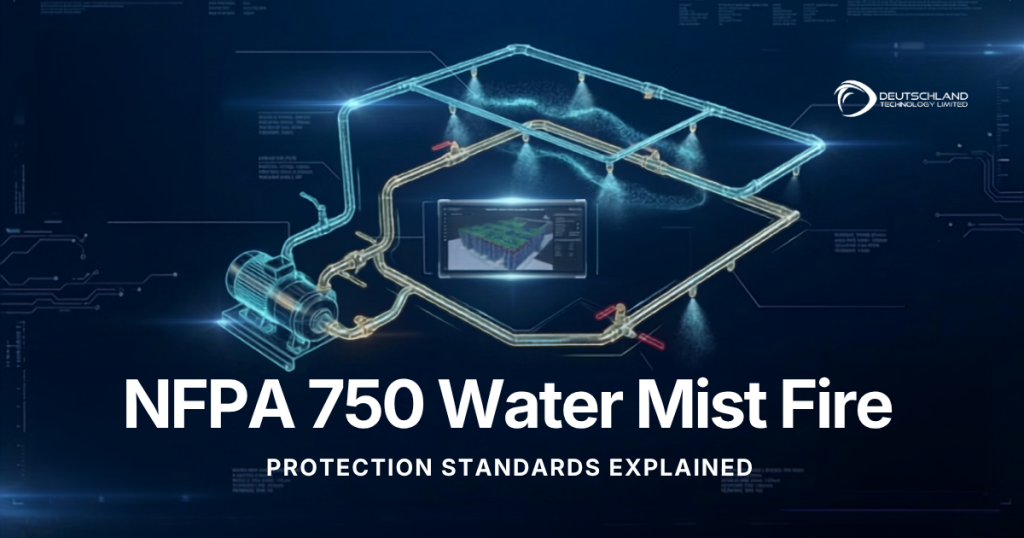
NFPA 750 Water Mist Fire Protection Standards Explained
Understanding the Standard Behind Water Mist Fire Protection Systems
The NFPA 750 standard on water mist fire protection systems is the engineering framework that governs how water mist systems are designed, tested, installed, and maintained. For facility owners, consultants, insurers, and fire protection engineers, it provides the benchmark for determining whether a water mist system will perform reliably under actual fire conditions.
As water mist technology continues to gain adoption across data centers, industrial facilities, marine environments, transportation infrastructure, and energy assets, understanding NFPA 750 has become increasingly important.
Deutschland Technology brings a unique connection to this standard. Dr. Mohamed Sorour, CEO of Deutschland Technology, serves as a Principal Special Expert on the NFPA 750 Technical Committee, contributing directly to the development and evolution of the standard. This involvement shapes how we approach every project—not simply as a compliance requirement, but as an engineering responsibility.
What Is NFPA 750?
The International Standard for Water Mist Systems
Published by the National Fire Protection Association (NFPA), NFPA 750 is a performance-based standard that requires water mist systems to be supported by application-specific fire test protocols. Rather than prescribing a single design approach, the standard ensures that water mist systems are validated for the specific hazards they are intended to protect.
The standard addresses:
- System design methodologies.
- Hydraulic calculations.
- Water supply requirements.
- Operating pressure criteria.
- Nozzle selection and positioning.
- Installation practices.
- Acceptance testing procedures.
- Inspection and maintenance requirements.
Unlike conventional sprinkler standards, NFPA 750 specifically addresses the unique operating characteristics of water mist technology, including droplet size distribution, discharge density, operating pressure, and hazard-specific fire testing requirements.
These factors directly influence system performance and cannot be addressed using traditional sprinkler design methodologies.
Why Water Mist Systems Require Their Own Standard
Understanding the Science Behind Water Mist Suppression
A high-pressure water mist system operates very differently from a conventional sprinkler system.
Rather than discharging large quantities of water, it generates extremely fine droplets that interact with fire through several thermodynamic mechanisms simultaneously.
These mechanisms include:
Rapid Heat Absorption
The fine droplets create a significantly larger surface area than conventional sprinkler discharge. This allows them to absorb thermal energy quickly and cool the fire environment more efficiently.
Flame Cooling
Water mist extracts heat directly from the combustion zone, interrupting the chemical reactions required to sustain the fire.
Oxygen Displacement
As droplets vaporize into steam, they displace oxygen around the flame front, helping slow combustion and suppress fire growth.
Radiant Heat Attenuation
The mist cloud acts as a barrier that reduces radiant heat transfer to nearby equipment, structures, and assets.
Because water mist performance depends heavily on droplet size, nozzle geometry, operating pressure, ventilation conditions, and hazard characteristics, dedicated engineering requirements are essential. NFPA 750 provides the framework that ensures consistent performance across these variables.
What Does NFPA 750 Cover?
System Design Requirements
The design process begins with identifying the specific hazard being protected.
One of the most important principles within NFPA 750 is that systems must be selected and designed based on fire test protocols appropriate for the intended application.
A system validated for one hazard cannot automatically be applied to another without supporting fire test data.
This requirement helps ensure that suppression performance remains predictable and reliable.
Common applications include:
- Data centers.
- Mission-critical electrical rooms.
- Industrial processing equipment.
- Cable tunnels.
- Marine vessels.
- Offshore platforms.
- Turbine enclosures.
- Transportation infrastructure.
- Cultural heritage facilities.
Water Supply Requirements
NFPA 750 establishes requirements for:
- Water quantity.
- System operating duration.
- Pressure availability.
- Pump arrangements.
- Water quality.
- Redundancy requirements where applicable.
These provisions help ensure that suppression systems can continue operating throughout the duration of a fire event.
Nozzle Performance Requirements
Nozzles are among the most critical components in a water mist system.
The standard addresses:
- Nozzle spacing.
- Coverage limitations.
- Minimum operating pressures.
- Discharge characteristics.
- Installation requirements.
Proper nozzle selection directly influences whether the system can generate the droplet sizes required to suppress the intended hazard.
Testing and Acceptance Procedures
Before a system enters service, NFPA 750 requires structured testing and commissioning activities.
These typically include:
- Functional testing.
- Flow verification.
- Pressure testing.
- Detection system integration.
- Acceptance testing.
These procedures verify that the installed system performs according to the approved design rather than relying solely on documentation and calculations.
Why NFPA 750 Matters for Critical Infrastructure
In facilities such as data centers, power generation plants, marine vessels, industrial facilities, and transportation systems, fire suppression is only one objective.
Organizations must also protect:
- Business continuity.
- High-value assets.
- Sensitive equipment.
- Operational reliability.
- Personnel safety.
Water mist systems support these objectives by providing effective fire suppression while using significantly less water than traditional sprinkler systems. This helps reduce collateral damage and operational disruption following a fire incident.
NFPA 750 ensures that these systems are engineered to perform consistently in the environments where the consequences of failure are greatest.
The Importance of Inspection and Maintenance
Compliance does not end when a system is commissioned.
NFPA 750 establishes ongoing requirements for:
- Routine inspections.
- Functional testing.
- Preventive maintenance.
- Documentation updates.
- Component verification.
Pumps, filtration systems, control panels, valves, and nozzle pathways all require periodic attention to maintain operational readiness.
A system that receives inadequate maintenance may not perform as intended when needed, regardless of how well it was originally designed.
Deutschland Technology’s Expertise in NFPA 750 Water Mist Systems
Deutschland Technology is also the only VdS-approved water mist installer outside Europe, a distinction that reflects both technical competency and quality-controlled installation practices across every project we deliver.
Deutschland Technology, part of DT Holding, delivers advanced water mist fire protection solutions for critical facilities worldwide.
Our project experience spans:
- Data centers.
- Industrial facilities.
- Marine applications.
- Energy infrastructure.
- Transportation systems.
- Power generation facilities.
- Critical infrastructure projects.
What differentiates Deutschland Technology is our direct involvement in the evolution of the standard itself.
Dr Mohamed Sorour’s role as a Principal Special Expert on the NFPA 750 Technical Committee provides our engineering teams with a level of technical insight that extends beyond conventional compliance training.
Our capabilities include:
- Water mist system design.
- Hydraulic calculations.
- HI-FOG® water mist solutions.
- Commissioning and acceptance testing.
- Authority Having Jurisdiction (AHJ) coordination.
- Inspection and maintenance programs.
- Industrial and mission-critical fire protection.
Every solution is engineered to meet operational requirements while aligning with NFPA standards, FM Approvals guidance, and project-specific risk profiles.
Conclusion
NFPA 750 establishes the engineering foundation that enables water mist fire protection systems to perform reliably across a wide range of applications.
From initial design through installation, testing, and long-term maintenance, the standard provides the framework required to achieve consistent suppression performance.
For organizations evaluating water mist technology, partnering with specialists who understand both the engineering principles and the standards behind them is critical.
Deutschland Technology combines direct involvement in the development of NFPA 750, global water mist expertise, and VdS-approved installation capabilities to deliver engineered fire protection solutions for critical facilities worldwide.
Contact Deutschland Technology to discuss how a properly engineered, NFPA 750-compliant water mist system can protect your facility, assets, and operations.
Frequently Asked Questions
What is NFPA 750?
NFPA 750 is the Standard on Water Mist Fire Protection Systems published by the National Fire Protection Association. It establishes requirements for the design, installation, testing, inspection, and maintenance of water mist systems.
Is compliance with NFPA 750 mandatory?
NFPA 750 becomes mandatory when adopted by local regulations, project specifications, insurance requirements, civil defense authorities, or the Authority Having Jurisdiction (AHJ).
Does NFPA 750 approve specific products?
No. NFPA 750 establishes engineering and performance requirements. Product approvals are issued by certification organizations such as FM Approvals and UL.
Why is hazard-specific fire testing important?
Water mist performance depends on the characteristics of the hazard being protected. NFPA 750 requires systems to be validated through fire testing appropriate to the intended application.
Where are NFPA water mist systems commonly used?
They are commonly used in data centers, marine vessels, industrial facilities, power plants, transportation infrastructure, electrical rooms, cable tunnels, and commercial buildings.
Where can I obtain the official NFPA 750 standard?
The official standard can be purchased directly from the National Fire Protection Association at nfpa.org.