
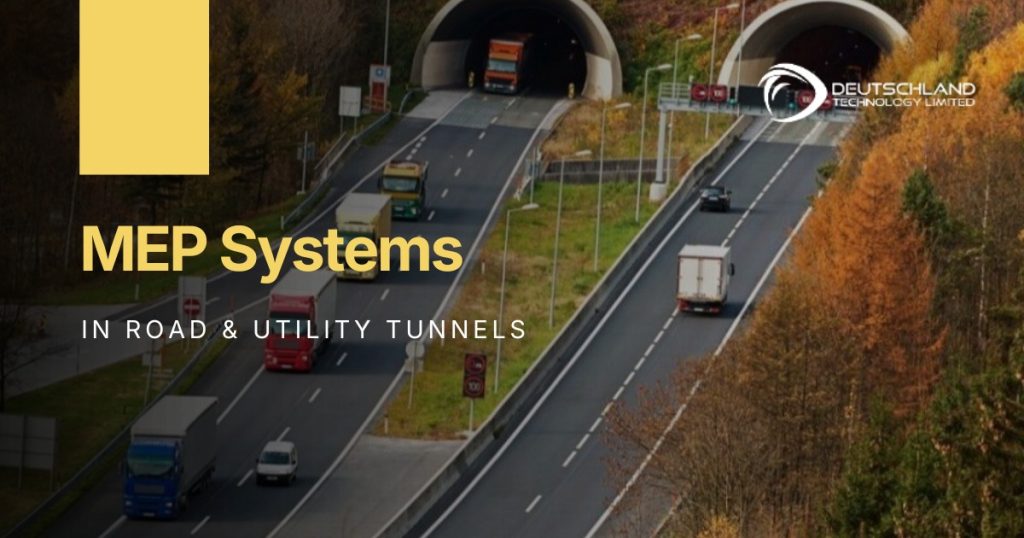
MEP Systems in Road & Utility Tunnels
Introduction
Road and utility tunnels are among the most complex infrastructure environments. Unlike traditional buildings, these confined underground spaces require carefully designed mechanical, electrical, and fire protection systems to ensure safety, functionality, and continuous operation.
In Egypt and across the Middle East, large-scale infrastructure projects depend on advanced MEP systems to manage ventilation, power, drainage, and tunnel fire protection effectively.
What Are MEP Systems in Tunnels?
MEP stands for:
- Mechanical systems
- Electrical systems
- Plumbing and infrastructure systems
In a tunnel environment, these systems work together to maintain safe conditions, support operations, and respond to emergencies.
Each system must be engineered to operate efficiently within the unique constraints of an underground utility tunnel, where space is limited and environmental conditions can change rapidly.
Mechanical Systems: Tunnel Ventilation and Environmental Control
One of the most critical elements in tunnel design is tunnel ventilation.
Ventilation systems are responsible for:
- Controlling air quality
- Removing vehicle emissions
- Managing heat levels
- Extracting smoke in case of fire
In emergency situations, ventilation plays a vital role in directing smoke away from evacuation routes, improving visibility and safety.
Mechanical systems may also include:
- Cooling systems
- Pressurization systems
- Airflow control mechanisms
Electrical Systems: Power and Communication
Electrical systems ensure that all tunnel operations run smoothly.
They include:
- Power distribution networks
- Lighting systems for visibility and safety
- Emergency backup power
- Communication and monitoring systems
Reliable electrical infrastructure is essential, especially during emergencies, where uninterrupted power is required to support ventilation and tunnel fire protection systems.
Fire Protection Systems in Tunnels
Fire incidents in tunnels present serious risks due to confined spaces and limited escape routes. That’s why tunnel fire protection systems must be highly efficient and responsive.
These systems are designed to:
- Detect fire at the earliest stage
- Control and suppress fire quickly
- Protect structural integrity
- Support evacuation procedures
Advanced solutions such as water mist systems are increasingly used in tunnels due to their ability to control fire with minimal water usage and reduced damage.
Drainage and Water Management Systems
Proper drainage is essential in any underground utility tunnel.
These systems handle:
- Water infiltration
- Firefighting water runoff
- Cleaning and maintenance flows
Efficient drainage prevents flooding and ensures that all other systems continue to operate effectively.
Integrated System Design
What makes tunnel MEP systems unique is their level of integration.
All systems must work together:
- Ventilation supports fire safety
- Electrical systems power all operations
- Fire protection systems rely on detection and control interfaces
- Drainage supports firefighting and maintenance
This integration ensures that tunnels remain safe, even under critical conditions.
Applications in Infrastructure Projects
MEP systems are essential in:
- Road tunnels and highway infrastructure
- Metro and rail tunnels
- Utility tunnels carrying services and networks
- Large-scale underground developments
In Egypt, infrastructure projects require reliable systems that meet international standards while adapting to local environmental and operational conditions.
Why Choose Deutschland Technology?
Deutschland Technology delivers advanced MEP and fire protection solutions for infrastructure projects, offering:
- Expertise in tunnel fire protection and ventilation systems
- Integration of mechanical, electrical, and safety systems
- Compliance with international standards
- Experience in complex and large-scale projects
Their approach ensures that every system is designed for performance, safety, and long-term reliability.
Real-World Application: Tunnel Projects in Egypt
In Egypt, large-scale infrastructure projects such as the Ahmed Hamdy Tunnel highlight the importance of well-designed MEP systems in underground environments.
Projects like this require:
- Advanced tunnel ventilation systems to manage air quality and smoke control
- Reliable tunnel fire protection solutions to ensure rapid response in confined spaces
- Integrated electrical and mechanical systems to support continuous operation
These real-world applications demonstrate how properly designed MEP systems are essential for ensuring safety, efficiency, and long-term performance in tunnel infrastructure.
Designing MEP systems for tunnels requires a deep understanding of how mechanical, electrical, and safety systems interact in confined environments. From tunnel ventilation to advanced tunnel fire protection, each component plays a critical role in maintaining safety and operational efficiency.
For modern infrastructure projects, a well-integrated MEP design is essential for long-term success.
Frequently Asked Questions (FAQs)
What are MEP systems in tunnels?
They are integrated mechanical, electrical, and infrastructure systems that ensure safe and efficient tunnel operation.
Why is tunnel ventilation important?
It controls air quality, removes smoke, and ensures safe conditions for users, especially during emergencies.
How does tunnel fire protection work?
It detects fire early and uses systems like water mist or suppression technologies to control and contain it.
What is an underground utility tunnel?
It is a tunnel designed to carry essential services such as cables, pipelines, and infrastructure systems.
If your project involves tunnels or underground infrastructure, having the right MEP design is critical.
Contact Deutschland Technology today to develop integrated tunnel systems that ensure safety, efficiency, and long-term performance.